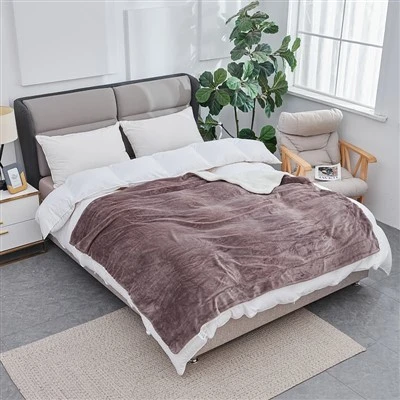
When it comes to double layer blankets, one common question that often arises is, "How many stitches are in a double layer blanket?" As a supplier of double layer blankets, this is a topic that I’ve delved into extensively. Understanding the number of stitches in a double layer blanket not only provides insight into its quality and craftsmanship but also impacts its overall feel and durability. Double Layer Blanket
Factors Influencing the Number of Stitches
The number of stitches in a double layer blanket can vary significantly based on several key factors. First and foremost, the size of the blanket plays a crucial role. Larger blankets naturally require more stitches to cover the increased surface area. For instance, a twin – sized double layer blanket will have fewer stitches compared to a king – sized one. A standard twin – sized blanket may measure around 66 inches by 90 inches, while a king – sized blanket can be approximately 108 inches by 90 inches. The additional length and width of the king – sized blanket mean that more rows and columns of stitches are needed to create the fabric.
The type of stitch used is another important determinant. Different stitches have different densities. For example, a simple running stitch is a relatively basic stitch that may be less dense compared to a whipstitch or a herringbone stitch. A running stitch is often used for quick and simple sewing projects and may leave more gaps between the threads. In contrast, a whipstitch is a more secure and dense stitch, which is commonly used to finish the edges of a blanket. The herringbone stitch, with its distinctive V – shaped pattern, is even more intricate and requires more stitches per unit area.
The yarn or fabric used also affects the stitch count. Thicker yarns generally require fewer stitches to cover an area because they take up more space. For example, a chunky wool yarn may have a lower stitch count compared to a fine cotton yarn. The texture of the fabric can also influence how the stitches are placed and how many are needed. A smooth fabric may allow for more precise and closely – spaced stitches, while a textured fabric may require a looser stitch pattern.
Calculating the Stitch Count
Calculating the exact number of stitches in a double layer blanket can be a complex task. However, we can use some basic mathematical principles to estimate it. First, we need to determine the stitch density, which is the number of stitches per square inch. This can be done by counting the number of stitches in a one – square – inch area of the blanket.
Let’s assume we have a double layer blanket made with a simple running stitch. We count the number of horizontal and vertical stitches in a one – square – inch section. Suppose we find that there are 8 horizontal stitches and 8 vertical stitches in this one – square – inch area. This means the stitch density is 8 x 8 = 64 stitches per square inch.
If our twin – sized blanket measures 66 inches by 90 inches, the total area of the blanket is 66 x 90 = 5940 square inches. To estimate the total number of stitches in the blanket, we multiply the stitch density by the total area of the blanket. So, using our example of 64 stitches per square inch, the estimated number of stitches in the twin – sized blanket would be 64 x 5940 = 380160 stitches.
For a king – sized blanket with dimensions of 108 inches by 90 inches, the total area is 108 x 90 = 9720 square inches. Using the same stitch density of 64 stitches per square inch, the estimated number of stitches in the king – sized blanket would be 64 x 9720 = 622080 stitches.
Importance of Stitch Count in Double Layer Blankets
The stitch count has a direct impact on the quality and performance of a double layer blanket. A higher stitch count generally indicates a more tightly woven or sewn blanket. This can result in a blanket that is more durable, as the increased number of stitches holds the layers together more securely. A tightly stitched blanket is also less likely to fray or come apart at the seams, even with regular use and washing.
In terms of comfort, a higher stitch count can contribute to a smoother and more luxurious feel. The closely – spaced stitches create a more uniform surface, which can be softer against the skin. Additionally, a well – stitched double layer blanket can provide better insulation. The stitches help to trap air between the layers, which acts as a natural insulator, keeping the user warm in cold weather.
Quality Control and Stitch Count
As a double layer blanket supplier, quality control is of utmost importance. We pay close attention to the stitch count during the manufacturing process. Our production team is trained to ensure that each blanket meets our strict standards for stitch density. We use advanced machinery and skilled artisans to create blankets with consistent and precise stitch counts.
Before a batch of blankets is shipped out, we conduct thorough inspections. We randomly select samples from each batch and carefully examine the stitch count and quality. Any blankets that do not meet our standards are either reworked or discarded. This rigorous quality control process ensures that our customers receive double layer blankets of the highest quality.
Customization and Stitch Count
One of the advantages of working with us as a double layer blanket supplier is the ability to customize the stitch count according to our customers’ needs. Some customers may prefer a blanket with a higher stitch count for added durability and luxury, while others may opt for a lower stitch count for a more casual and breathable feel.
We offer a range of customization options, including different stitch types, yarns, and stitch densities. Our design team can work closely with customers to create a double layer blanket that meets their specific requirements. Whether it’s a custom – sized blanket for a unique application or a blanket with a special stitch pattern, we have the expertise and resources to bring the vision to life.
Conclusion
In conclusion, the number of stitches in a double layer blanket is influenced by various factors such as size, stitch type, and yarn. While calculating the exact stitch count can be challenging, we can estimate it using basic mathematical principles. The stitch count is an important factor in determining the quality, comfort, and performance of a double layer blanket.
Blanket At our company, we are committed to providing high – quality double layer blankets with precise stitch counts. Our dedication to quality control and customization ensures that our customers receive blankets that meet their expectations. If you are interested in purchasing double layer blankets for your business or personal use, we invite you to contact us to discuss your requirements and start a procurement negotiation. We look forward to working with you to create the perfect double layer blankets.
References
- "Textile Manufacturing Processes" – A comprehensive guide on how stitches are used in the textile industry.
- "Handbook of Sewing and Machine Embroidery" – Provides in – depth knowledge about different types of stitches and their applications in blanket making.
- "Fabric Science and Technology" – Researches the relationship between stitch density, fabric type, and the overall quality of textile products.
Jiangsu Etang Household Products Co., Ltd.
We are one of the most professional double layer blanket manufacturers and suppliers in China. With abundant experience, we warmly welcome you to buy bulk premium double layer blanket made in China here from our factory. All customized products are with high quality and competitive price. Contact us for pricelist.
Address: No. 18 Nanhai Road, Siyang Economic Development Zone, Siyang County, Suqian City, Jiangsu Province
E-mail: etang216@js-et.com
WebSite: https://www.etangbedding.com/
