As a provider of phase sequence relays, I’ve spent countless hours dealing with these critical electrical components. Phase sequence relays play a fundamental role in ensuring the correct operation of electrical systems, especially those with three – phase power. They are designed to monitor the phase sequence of three – phase power supplies and take appropriate actions when the sequence is incorrect. However, like any electrical equipment, they are prone to certain faults. In this blog, I will delve into the common faults of phase sequence relays and share some insights based on my years of experience in the industry. Phase Sequence Relay
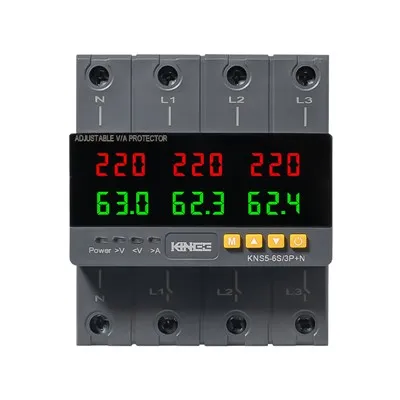
Incorrect Phase Sequence Detection
One of the most prevalent faults in phase sequence relays is incorrect phase sequence detection. A phase sequence relay is supposed to accurately identify the correct sequence of the three – phase power system, typically designated as RYB (Red – Yellow – Blue) or L1 – L2 – L3. When it fails to do so, there can be a range of issues.
The root cause of this problem can often be traced to installation errors. If the relay is not properly wired, the input phases may be misconnected. For example, if the R and Y phases are swapped during installation, the relay will detect an incorrect phase sequence and might trip the system unnecessarily. In some cases, loose connections can also lead to this fault. Over time, vibrations and temperature changes can cause the wiring connections to become loose, which may disrupt the correct signal transmission to the relay’s sensing elements.
Another contributing factor is the presence of high electrical noise in the system. Electrical noise can interfere with the weak signals that the relay uses to detect the phase sequence. Sources of electrical noise can include nearby industrial motors, power electronics equipment, and even lightning strikes. In a manufacturing environment with a large number of motors running simultaneously, the electromagnetic interference generated by these motors can be so strong that it masks the true phase sequence signal, leading to false detections by the relay.
Relay Failure to Trip or Incorrect Tripping
A phase sequence relay is designed to trip the circuit when it detects an incorrect phase sequence. However, it may fail to trip when it should or may trip when there is actually no phase sequence problem.
When a relay fails to trip, it can pose a serious safety hazard. In a three – phase motor, for example, an incorrect phase sequence can cause the motor to rotate in the wrong direction, which can damage the motor and the connected machinery. The failure to trip could be due to a malfunctioning internal trip mechanism. The relay’s contacts, which are responsible for opening and closing the circuit, may become stuck in the closed position. This can happen due to mechanical wear, overheating, or the presence of contaminants on the contact surfaces.
On the other hand, incorrect tripping can disrupt the normal operation of the electrical system. False tripping can be caused by transient voltage fluctuations. These fluctuations can occur during power grid disturbances, such as sudden load changes or short – circuits. The relay may interpret these transient changes as an incorrect phase sequence and trip the circuit. Additionally, a faulty internal sensing circuit can also lead to incorrect tripping. If the relay’s internal components, such as resistors or capacitors, degrade over time, they can cause the relay to generate false trip signals.
Overheating
Overheating is another common fault in phase sequence relays. Excessive heat can damage the internal components of the relay and reduce its lifespan.
One of the primary causes of overheating is overloading. If the relay is subjected to a current or voltage that exceeds its rated capacity, it will generate more heat than it can dissipate. This can happen when the electrical system experiences a sudden increase in load, or if the relay is incorrectly rated for the application. For example, if a relay with a low – current rating is used in a high – current circuit, it will overheat quickly.
Poor ventilation can also contribute to overheating. Phase sequence relays are typically installed in electrical panels or enclosures. If these enclosures have inadequate ventilation, the heat generated by the relay cannot be effectively dissipated. In a confined space, the temperature can rise rapidly, especially in a hot environment or when there are other heat – generating components in the same enclosure.
Display or Indication Issues
Many modern phase sequence relays are equipped with display units or indicator lights to show the status of the phase sequence. Display or indication issues can make it difficult for operators to monitor the relay’s operation accurately.
A malfunctioning display can be the result of a defective LCD module. LCDs are sensitive components, and they can be damaged by power surges, static electricity, or physical impacts. If the LCD is damaged, it may show incorrect or no information at all.
Indicator lights can also fail to function properly. This can be due to a blown fuse in the indicator circuit, a broken connection, or a faulty LED. When the indicator lights are not working correctly, operators may not be aware of the relay’s status, which can lead to delays in detecting and addressing phase sequence problems.
Communication Problems
In today’s smart electrical systems, phase sequence relays are often connected to communication networks for remote monitoring and control. Communication problems can prevent the relay from sending or receiving data correctly.
One common communication fault is a network connection issue. If the relay is connected to an Ethernet or Modbus network, a loose cable, a faulty network switch, or incorrect network settings can disrupt the communication. For example, if the IP address of the relay is misconfigured, it will not be able to communicate with the central monitoring system.
Another problem can arise from compatibility issues. Different communication protocols and standards are used in the electrical industry. If the relay and the monitoring system do not support the same protocol, they will not be able to communicate effectively. Additionally, software bugs in the relay’s communication firmware can also cause communication problems.
How to Address These Faults
To prevent and address the common faults of phase sequence relays, proper installation and maintenance are crucial. During installation, it is essential to follow the manufacturer’s wiring diagrams carefully to avoid incorrect phase connections. Regularly checking the wiring connections for tightness can also prevent loose connections from causing problems.
To mitigate the effects of electrical noise, shielding the relay’s input wires can be an effective solution. Shielded cables can help reduce the interference from external sources. Additionally, installing a surge protector can protect the relay from transient voltage fluctuations.
For overheating issues, ensuring proper ventilation in the electrical enclosure is key. This can be achieved by installing fans or ventilation grilles. It is also important to select a relay with the correct current and voltage ratings for the application.
When it comes to display and indication problems, replacing defective LCD modules or LEDs can restore the functionality of the display and indicator lights. Checking the fuses in the indicator circuits regularly can prevent fuse – related failures.
To solve communication problems, double – checking the network connections and settings is the first step. Updating the relay’s communication firmware can also fix software – related bugs. If compatibility issues are detected, upgrading the relay or the monitoring system to support the same protocol may be necessary.
Conclusion

Phase sequence relays are essential components in three – phase electrical systems, but they are not immune to faults. Incorrect phase sequence detection, failure to trip or incorrect tripping, overheating, display or indication issues, and communication problems are some of the common faults that can occur. As a phase sequence relay provider, I understand the importance of these relays in ensuring the safe and efficient operation of electrical systems. By being aware of these common faults and taking appropriate preventive and corrective measures, users can minimize the downtime and potential damage caused by relay failures.
Proximity Sensor If you are facing issues with phase sequence relays or are in the market for high – quality relays, I encourage you to reach out to me. We can discuss your specific requirements and find the most suitable solutions for your electrical systems. Let’s work together to ensure the reliability of your three – phase power applications.
References
- Electrical Equipment Maintenance Handbook
- Three – Phase Power Systems: Principles and Applications
- Relay Technology and its Applications in Electrical Engineering
Wenzhou Kinee Electrical Co., Ltd.
We are one of the most professional phase sequence relay manufacturers and suppliers in China, featured by quality products and good price. Please rest assured to buy advanced phase sequence relay made in China here from our factory. We also accept customized orders.
Address: Unit 1, Building 31, Wenzhou Wenbo Science and Technology Industrial Park, No. 706 Yanyun Road, Lingkun Street, Oujiangkou Industrial Cluster Area, Wenzhou, Zhejiang Province
E-mail: sandyma@kinee.net
WebSite: https://www.kinee.net/
